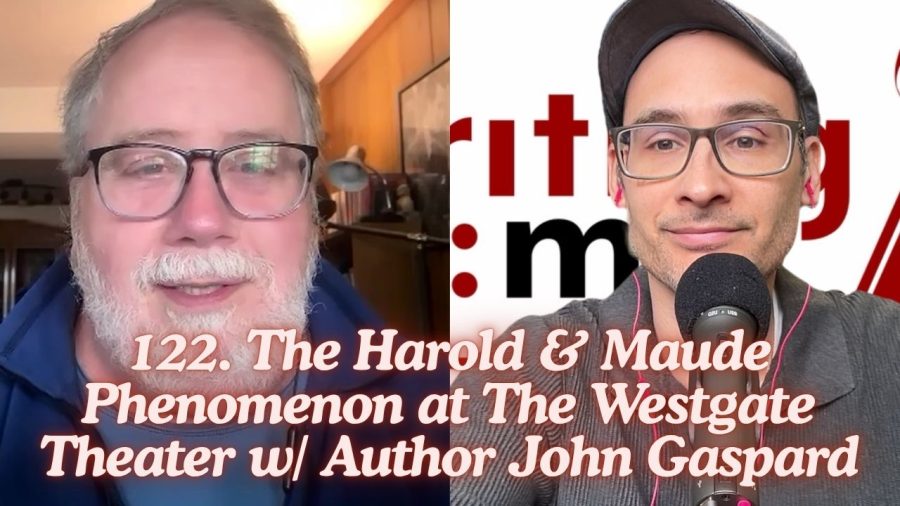
On this episode of Writing Remix, Dan talks to John Gaspard, the author of Held Over: Harold and Maude at the Westgate Theater. During a time when large movie theaters are trying to figure out how to bring in the crowds and rival streaming services, John and Dan discuss how the movie Harold and Maude played for two years at The Westgate. John unpacks why audiences were so obsessed with the film, how the studios had no clue how to advertise Harold and Maude, the fading communal experience of watching a movie in a theater, the role that small neighborhood movie theaters played in small towns, and what it was like to live in a time pre-VHS.
This episode provides a bit of hope during a time when hope seems to be fading. It gives us something to remember and be nostalgic for, that place where people went to experience a wide array of emotions together as collective event of shared humanity. As John says in this episode, Harold and Maude was a feel-good movie during a time, in the 70s, when there weren’t a lot of feel-good films to go see. In a similar way, we’ve been overwhelmed with movies and media that exploit people, celebrate violence, and flood our senses with tragedy. This episode attempts to shed light on a singular moment when a small quirky film provided people with a little joy.
Approximate Rundown
00:00 Welcome and Guest Intro
00:34 John Gaspard Background
01:10 Why Write the Book
02:45 How the Cult Hit Happened
06:28 Neighborhood Theaters Era
07:37 Communal Movie Magic
11:46 Westgate Secret Sauce
12:57 Critics and Word of Mouth
15:26 Designing the Photo Book
17:22 Westgate History and Decline
20:05 What We Lost with Multiplexes
23:20 Dark Comedy and Risky Films
26:56 Streaming Choice Overload
28:25 Bad Movies Together
29:11 Jelly Study Decision Fatigue
31:26 When Movies Disappeared
32:11 VHS Changed Everything
33:58 Monster Kid TV Rituals
36:20 Working the Westgate
38:21 Harold and Maude Film School
42:15 Neighborhood Theater Comeback
45:20 What the Book Captures
48:37 Libraries and Coffee Table Book
51:01 Final Plugs and Farewell
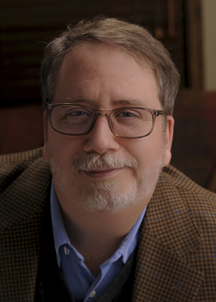
John Gaspard is an author, filmmaker, and podcaster. His latest book, Held Over: Harold and Maude at The Westgate Theater, documents how Minneapolis’ Westgate Theater extended the run of a box-office flop until it became a cult favorite, drawing celebrity visits, superfans, and neighborhood protests.
He writes two mystery series: the ten-book Eli Marks Mystery Series, featuring a magician-turned-detective, and the three-book Como Lake Players Mystery Series, set in a community theater where backstage tensions turn deadly.
On Behind the Page: The Eli Marks Podcast, he hosts interviews with entertainers, magicians and others, along with readings from The Eli Marks mystery series of novels.
John also wrote episodes for the international western-comedy television series Lucky Luke, starring Terence Hill, who’s as quick to pick up a check in real life as his character is at drawing a six-gun on screen.
Gaspard is also the author of Fast, Cheap, and Under Control and Fast, Cheap, and Written That Way, best-selling nonfiction guides to low-budget filmmaking. He has directed and produced six feature films. Ironically, the books made more than the movies.
Next Up: The 20th Anniversary Special Edition of Fast, Cheap, and Under Control (Lessons Learned From the Greatest Low-Budget Movies of All Time) will be published in 2026.
***
Held Over: Harold and Maude at The Westgate Theater can be found here: https://www.albertsbridgebooks.com/ – /held-over-harold-and-maude-at-the-westgate-theater/
The Eli Marks Mysteries and The Como Lake Players Mysteries can be found here: https://www.albertsbridgebooks.com/eli-marks
The Filmmaking Books can be found here: https://www.fastcheapfilm.com/
People, Texts & Podcasts Mentioned in the Episode
- Held Over: Harold and Maude at The Westgate Theater (Second Edition) by John Gaspard
- Harold and Maude (movie 1971)
- Ruth Gordon
- Bud Cort
- The Westgate Theater
- Pete Bart
- The Godfather (movie 1972)
- Mel Brooks
- The Twelve Chairs (movie 1970)
- Where’s Poppa? (movie 1970)
- The Sound of Music (movie 1965)
- Yusuf Islam/Cat Stevens
- Easy Rider (movie 1969)
- De Düva: The Dove (short film 1968)
- Ingmar Bergman
- Will Jones
- Design for Writers
- Pantages Theater
- La Paloma Theater
- Carl Reiner
- King of Hearts (movie 1966)
- The Tall Blonde Man with One Black Shoe (movie 1972)
- Homebodies (movie 1974)
- Hal Ashby
- Chinatown (movie 1974)
- The Parallax View (movie 1974)
- Donna Smith
- The Cell (movie 2000)
- Jennifer Lopez
- Vincent D’Onofrio
- TV Guide
- Lawrence Welk
- Abbott and Costello
- Abbott and Costello Meet Frankenstein (movie 1948)
- Jurassic Park (movie 1993)
- The Magic Flute (opera premiered 1791)
- Beyond Bob (movie 1993)
- Francis Ford Coppola
- Peter Bogdanovich
- Brain Dead Studios
- Quentin Tarantino
- The Heights Theater
- The Music Box Theater
- Parkway Theater
- Casablanca (movie 1942)
- Beat the Devil (movie 1953)
- Singing in the Rain (movie 1952)
- Fast, Cheap, and Under Control: Lessons Learned from the Greatest Low Budget Movies of All Time by John Gaspard
- Roger Corman
- Steven Soderbergh
- John Favreau
- Tom Nunan
- Kasi Lemmons
- Behind the Page: The Eli Marks Podcast
“I got an idea that the movie Harold and Maude played for two years here in Minneapolis, in my hometown, and I was part of that, I saw it multiple times at the same theater, and I thought no one’s ever done a book about how Harold and Maude went from crashing and burning in December of 71 to being resurrected in March of 72, and then playing over two years in [The Westgate Theater] and then kind of bopping around to other theaters for the next few years doing the same thing [in] Ann Arbor, Michigan, Boston, Paris, Toronto, all over the place.”
-John Gaspard
“For the theater owners it was definitely financial. The only reason they kept it running for over two years was that it was continuously making money and neighbors would call up and complain.”
-John Gaspard
“I came back the next afternoon to see it again because the reaction from the audience was so effusive that I felt like I’d missed about half the movie ’cause the audience was so into it.”
-John Gaspard
“I think seeing Harold and Maude again and again and again was a far better education because Hal Ashby was a brilliant director and a brilliant editor, and although he didn’t physically cut Harold and Maude, he certainly has his fingerprints all over it.”
-John Gaspard
“In fact, [Harold and Maude] is still shown every Sunday evening at a theater in Germany that has never stopped showing it, I think even during COVID they ran it […] It’s shown once a week there.”
-John Gaspard
“[Harold and Maude] is also a classic feel-good movie. The soundtrack is from Cat Stevens and […] you walk out of that movie feeling good […] In the early seventies there weren’t a lot of movies where you walked outta there feeling good. When The Godfather finally came out, you didn’t walk outta there feeling good. When Easy Rider was over, you didn’t walk out there feeling good. There was a certain darkness to a lot of movies in the early seventies and this one was a pretend darkness.”
-John Gaspard
Episode Reflection Questions:
- Reflect on your favorite and/or most impactful movie going experience. Be detailed.
- Write about a movie that lives in your bones, that one movie that’s become part of you. Write about when you saw it, how many times you’ve seen it, and how it changed you.
- This one is going to take a little more time. Find a neighborhood theater or a small indie theater. Make plans to make a day or night of the experience, maybe with a group or not. Get food, maybe some drinks, and go to the movies.
After the movie, find a place to debrief the movie. Write about this whole experience, take photos, share with Writing Remix writingremixpodcast@gmail.com or post your experience on Instagram with #NostalgicMovieNight and tag Writing Remix @WritingRemixPod
122. The Harold & Maude Phenomenon at The Westgate Theater w/ Author John Gaspard (Transcript)
The theme song is “4 am” by Makaih Beats. You can follow the podcast & all social media: Linktree, join the newsletter/Follow Dan’s Medium & Follow the Substack to watch the full episode videos
 Writing Remix Podcast