129: What I Learned After 6 Years of Podcasting: A Talk at the 2026 Undergraduate Writer’s Conference at USC

At the Undergraduate Writer’s Conference at USC, Daniel gave a talk about what he learned from his experiences being a podcaster for the last six years. He shared the stories of both Writing Remix and The Nostalgia Test’s humble beginnings, how COVID impacted the recording process, seeing mistakes as lessons to improve workflow, creating boundaries, confronting burnout, and the importance of being authentic versus having an over-produced podcast.

He also talks about how podcasting taught him so much about who he is as a creative, scholar, and personally, which Daniel sees as the greatest lesson. After the presentation, he answers questions from USC students in the audience about engaging in courageous conversations, the ups and downs of being so public with one’s views, and his approach to preparing for guests.

If you want to book me for workshops, speaking events, and/or to be a guest on your podcast email at writingremixpodcast@gmail.com

Continue reading “129: What I Learned After 6 Years of Podcasting: A Talk at the 2026 Undergraduate Writer’s Conference at USC”
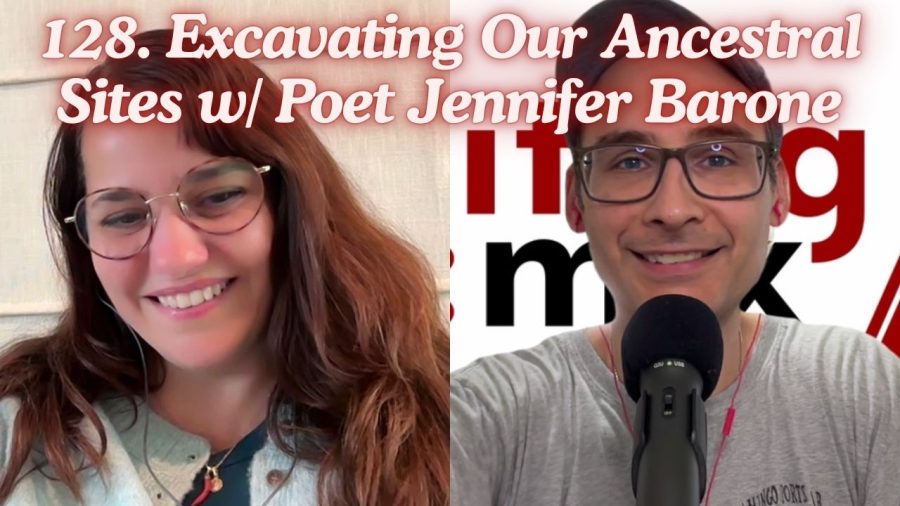
128. Excavating Our Ancestral Sites w/ Poet Jennifer Barone

On this episode, Daniel Dissinger speaks with Italian-American Bay Area poet and artist Jennifer Barone. Jennifer’s newest book of poems, Sirenland, is the result of a ten year period of traveling to Italy, researching and visiting the sacred and familial sites of Naples, Vesuvius, and Pompeii, and re-positioning the Sirens themselves to present them in all their mythic glory.

This conversation weaves in and out of mythology, what it means to reconnect to one’s ancestral roots and history, specifically the Italian-American experience, how sacredness plays a role in our personal excavations, and the spiritual experience of living in the cross-section of birth, death, and destruction. Jennifer Barone also shares a poem from her collection Sirenland and reflects on how learning Italian opened the channel for her to have conversations with her Nonna in her dreams, in Italian.

With our experiences as humans becoming more confusing with AI being forced on all of us without our consent, this episode challenges us to take more than a few moments to find what it means to be human, to be part of a community, to examine where we come from and what histories, mythologies, and folklore run through our blood. Jennifer asks us why we’re so hesitant to get closer to our dead, to grieve and mourn together, to talk to our deceased family, to celebrate their lives, and to pilgrimage to where it all started for our families. In this 21st century world, we’re inundated with so much information it’s hard to discern what’s important, what’s real, and what’s false, and yet we’re good at consuming all of these ideas. Why can’t we put the same energy into stopping and asking ourselves, “What’s meaningful to me?”

Jennifer Barone will leave us wanting to go out on our own quests, to excavate the ruins of our familial sacred sites, and finally fill the gaps that are causing so much disconnection and pain.

Continue reading “128. Excavating Our Ancestral Sites w/ Poet Jennifer Barone”

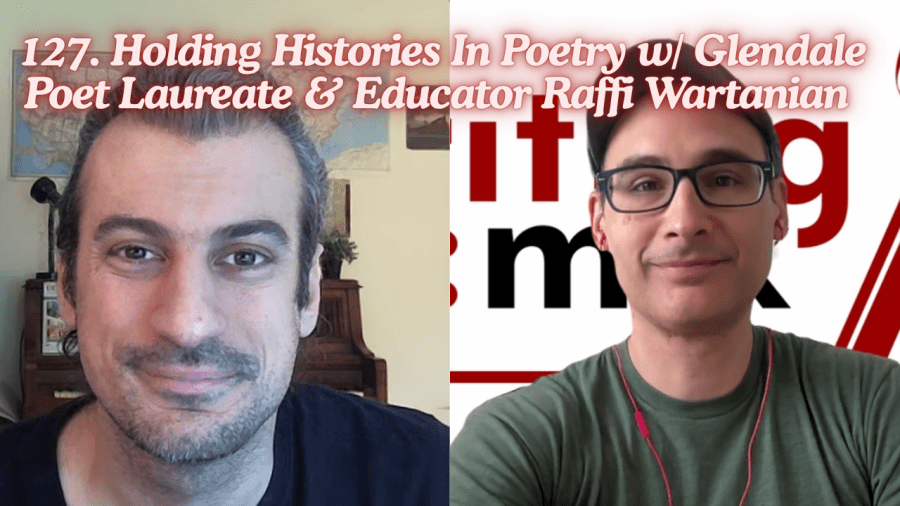
127. Holding Histories in Poetry w/ Glendale Poet Laureate & Educator Raffi Wartanian

On this episode, Daniel Dissinger talks with Glendale’s first Poet Laureate and UCLA Writing Program professor Raffi Wartanian. This Writing Remix starts out with Raffi reading and sharing (check out the video episode on Substack) three poems as his bio. In the six years of Writing Remix, this is a first, and it’s always good to know that there are still firsts to be had this deep into this growing archive.

Raffi Wartanian takes the audience deep into the history and impact of the Armenian Genocide, how this tragedy has created cultural, political, and personal repercussions, the power that poetry has as a vessel for historical narrative and conservation, how backpacking after college from France to Portugal, hiking along the Camino de Santiago in Spain, then going to Marseille, Cyprus, Lebanon, Kuwait, and the UAE became this moment of poetic birth for him. Raffi also discusses what it’s like to be the first Poet Laureate of Glendale and the mix of responsibility, joy, and challenge of this position.

Oh! And how can we forget to mention the time he biked from Baltimore to San Francisco as part of a cancer fundraiser.

Saying that Raffi Wartanian is an active poet doesn’t do justice to the number of experiences he’s had, the number of projects he is involved in and is creating, and the dedication he has to his students at UCLA, not to mention his growing music career.

The conversation on the podcast weaves through so many spaces and ends on a much-needed conversation on rest, relaxation, and peace.

Continue reading “127. Holding Histories in Poetry w/ Glendale Poet Laureate & Educator Raffi Wartanian”

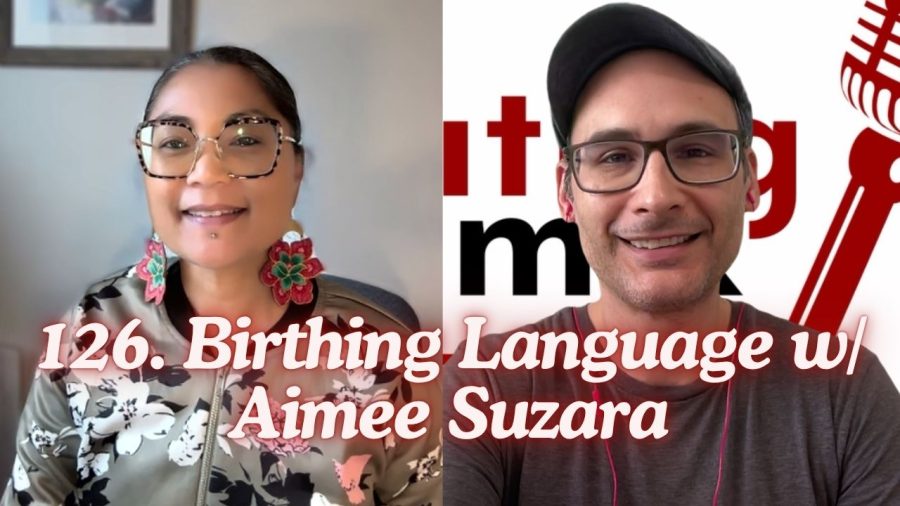
126. Birthing Language w/ Aimee Suzara

On this episode of Writing Remix, Dan talks with Oakland-based Poet, Playwright, & Educator Aimee Suzara. The beauty of this episodes wildness is raw and poetic, because their conversation goes into the power of multi-hyphenate creative being, how Aimee is fueled by her Filipino-American identity to learn, create, and archive in her work, the impact of flipping the gaze in her research, and re-examining folklore and mythology outside their restrictive parameters.

Aimee speaks on her poetic evolution from her book Souvenir to her forthcoming book Birth Language and its multilingual poetic landscape. Aimee speaks about the role of archival research, ceremony, and invocations play in Birth Language and she unpacks the book’s cover design by artist Malaya Tuyay and its relationship to the  This is the part of the podcast where both Aimee and Dan are swept up in the exchange of ideas, experiences, and Aimee’s reading of two poems that totally leave Dan speechless. There’s an improvisational energy to the episode, a freeness that steers Dan and Aimee into a conversation on mothering and the action of it, and how many of us are mothering outside our traditional knowledge of what it means to mother.

Continue reading “126. Birthing Language w/ Aimee Suzara”

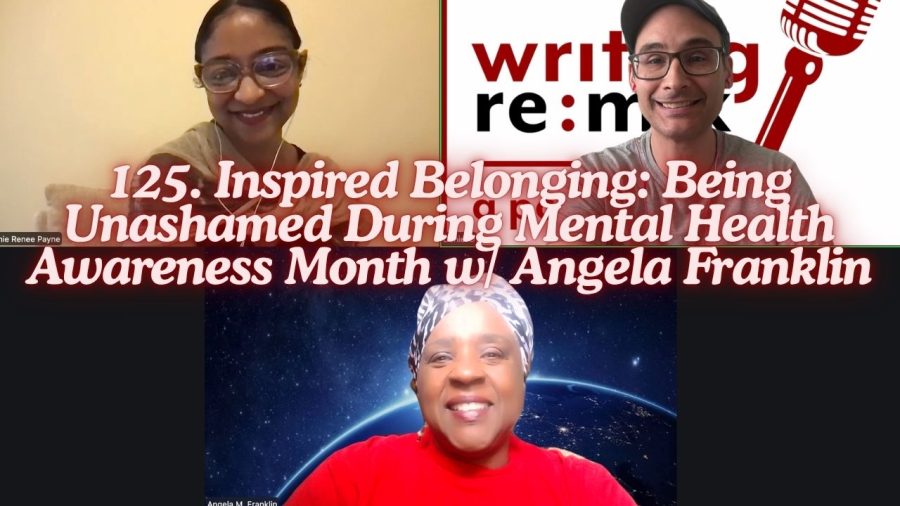
125. Inspired Belonging: Being Unashamed During Mental Health Awareness Month w/ Angela Franklin

Content Warning
This episode deals with discussions of Domestic Violence, PTSD, Depression, Schizophrenia & Suicide Ideation.

If you or someone you know is struggling:

On this special Mental Health Awareness episode of Inspired Belonging on Writing Remix, Daniel & Stephanie Renee Payne talk to the LA-based poet, essayist, visual artist, and documentarian Angela Franklin. Their open and honest conversation leaves Dan and Stephanie nearly speechless. Angela shares her experiences with her late brother who suffered from schizophrenia and homelessness, the challenges of finding help and care in a society that is looking to erase and ignore people with mental health issues, the intersectional complexity that race, gender, and class has on sufferers of mental health problems, as well as the families of these individuals, and what the role of creativity and poetry are in times of grief, pain, and rebuilding.

Angela Franklin shares to poems, the upcoming anthology that her work is part of, 88 Unashamed Black Mental Health Stories, and so much more. This is one of those episodes that stays with you after you listen. Share this with as many people as you can, because we’re all thinking we’re alone on these human journeys when there’s an infinitely deep and beautiful community out there waiting to embrace us all. Embrace each other.

Continue reading “125. Inspired Belonging: Being Unashamed During Mental Health Awareness Month w/ Angela Franklin”

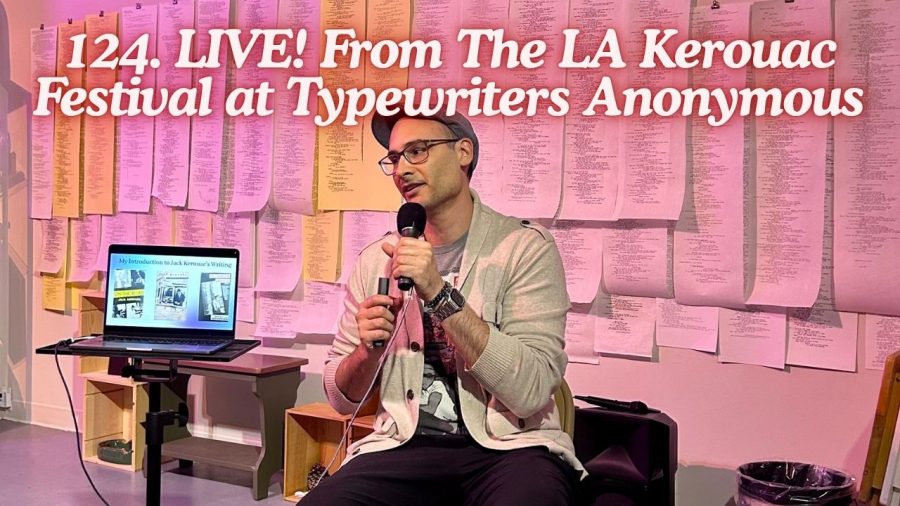
124. LIVE! From The LA Kerouac Festival at Typewriters Anonymous: The Kerouac We Ignore w/ Daniel Dissinger

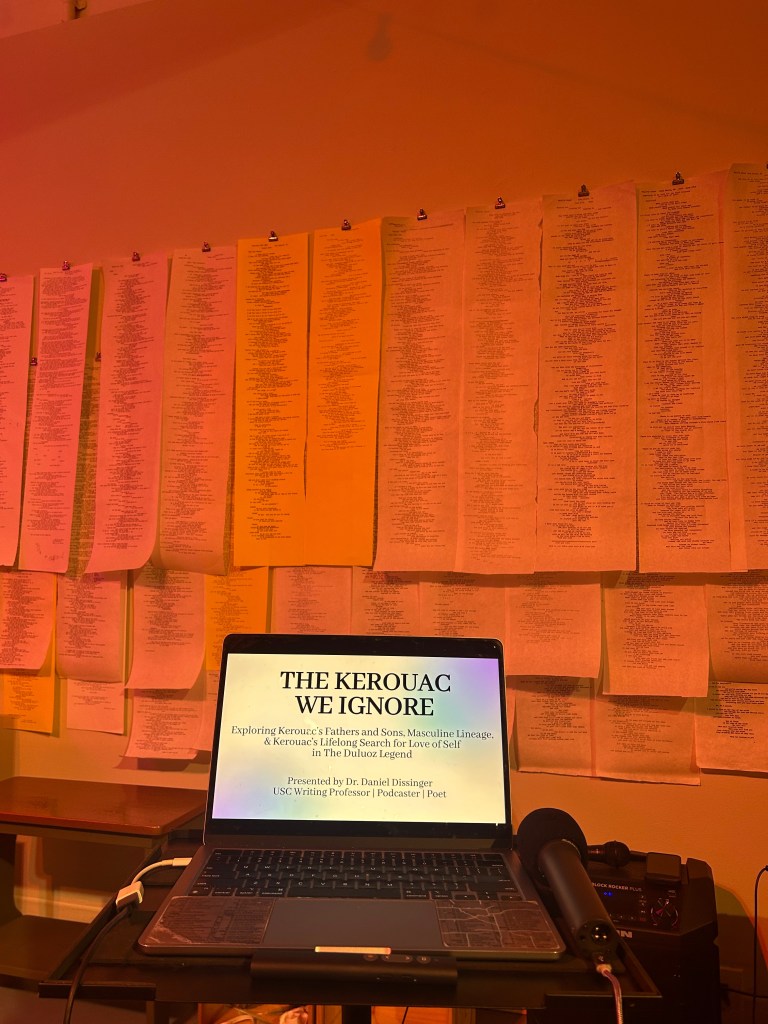
Daniel Dissinger recorded live from Typewriters Anonymous to give the keynote talk at the LA Kerouac Festival on April 18th, 2026. His talk, “The Kerouac We Ignore,” opens a much-needed conversation into Kerouac’s pre-On the Road work and introduces a nuanced analysis of father-son relationships, masculinity, vocational identity, and Kerouac’s lifelong search for love, both of self and others. Daniel brings the audience through his deeply personal journey with Kerouac’s books, the three books that started him on the Kerouac journey, his scholastic instinct that something was wrong with the transition from The Town and the City to On the Road, how seeing the On the Road scroll at the Denver Public Library in 2007 changed everything, and what the opening lines of the scroll version confirmed for him.

bell hooks’ works All About Love and The Will to Change come into the conversation and this is where Daniel shows how generational trauma, specifically connected to hyper-masculinity and patriarchy created for Kerouac a misunderstanding and inability love himself for the man he was and how his whole life became an unending desire to prove his worth in a patriarchal world. At the end of the talk, Daniel answers some questions from the audience about Kenneth Rexroth, the difference between loneliness and solitude, why did he bring bell hooks into the Kerouac scholarship, and so much more.

I hope you enjoy this episode. A special thank you to Philip and Elizabeth Nails at Typewriters Anonymous for having and supporting this amazing event.

Continue reading “124. LIVE! From The LA Kerouac Festival at Typewriters Anonymous: The Kerouac We Ignore w/ Daniel Dissinger”

123. A Joyful Poetry Resistance w/ Alexis Jaimes

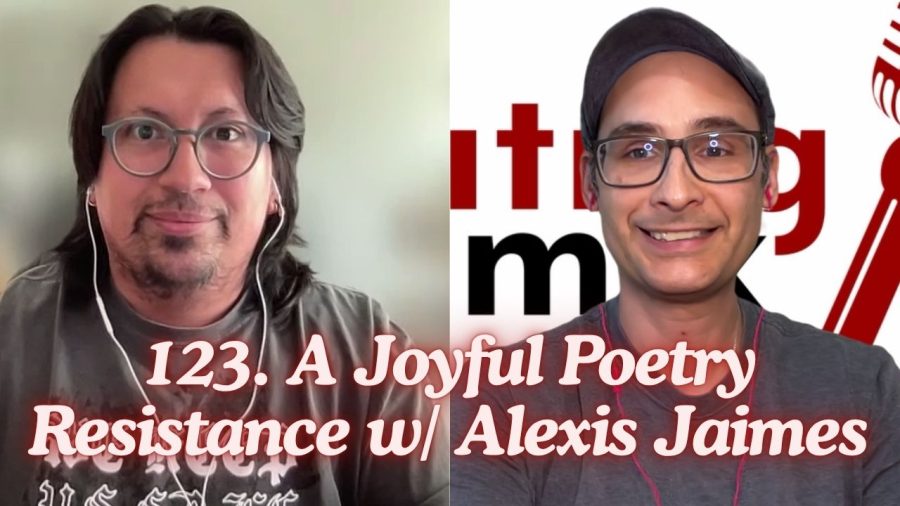
Writing Remix is kicking off National Poetry Month with poet & educator from Orange County Alexis Jaimes. This episode explores the connection and close affection Alexis has for Santa Ana. He discusses the misrepresentation of Santa Ana and sets the record straight by celebrating and highlighting the depth of its culture, from food to art to its community organizations. Alexis also talks about the how since moving to Fullerton he’s seeing the roots of Santa Ana in his poetry, as well as the vulnerable self-reflective journey addressing family trauma, masculinity, and cycles of abuse in his new forthcoming collection The Seeds We Sow (Daxson Publishing). He talks about balancing his work with a poetics of joy and celebration which leads Dan and Alexis into a conversation about joy as a source of resistance. Alexis shares his poem “On the Car Stereo.”

As an 4th grade teacher, Alexis is doing the hard work, the deep work, and the much-needed work for his students during these unpredictable and violent times. He’s the sort of educator courageously facilitating and mentoring his students through conversations and questions about ICE, deportation, and oppression, while introducing them to literature that they see themselves in, pushing against the misnomer that students don’t want to read.

Continue reading “123. A Joyful Poetry Resistance w/ Alexis Jaimes”

122. The Harold & Maude Phenomenon at The Westgate Theater w/ Author John Gaspard

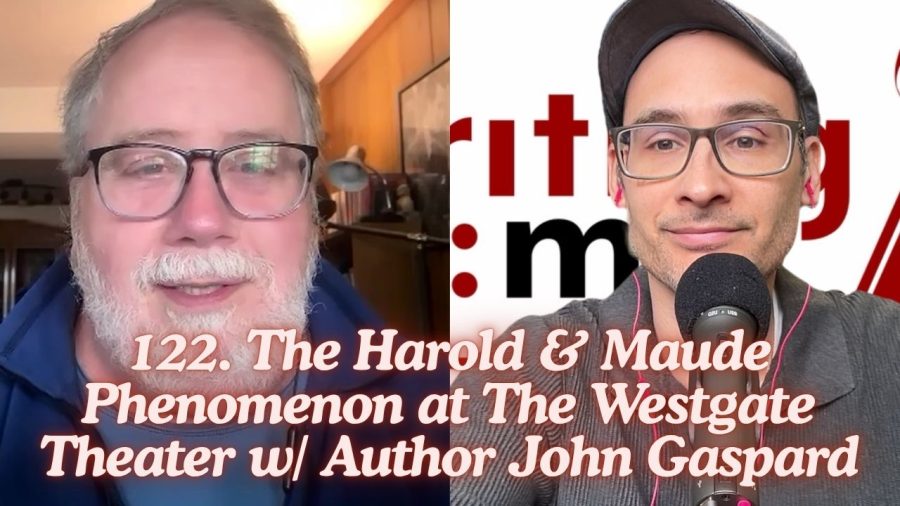
On this episode of Writing Remix, Dan talks to John Gaspard, the author of Held Over: Harold and Maude at the Westgate Theater. During a time when large movie theaters are trying to figure out how to bring in the crowds and rival streaming services, John and Dan discuss how the movie Harold and Maude played for two years at The Westgate. John unpacks why audiences were so obsessed with the film, how the studios had no clue how to advertise Harold and Maude, the fading communal experience of watching a movie in a theater, the role that small neighborhood movie theaters played in small towns, and what it was like to live in a time pre-VHS.

This episode provides a bit of hope during a time when hope seems to be fading. It gives us something to remember and be nostalgic for, that place where people went to experience a wide array of emotions together as collective event of shared humanity. As John says in this episode, Harold and Maude was a feel-good movie during a time, in the 70s, when there weren’t a lot of feel-good films to go see. In a similar way, we’ve been overwhelmed with movies and media that exploit people, celebrate violence, and flood our senses with tragedy. This episode attempts to shed light on a singular moment when a small quirky film provided people with a little joy.

Continue reading “122. The Harold & Maude Phenomenon at The Westgate Theater w/ Author John Gaspard”

121. Navigating AI & Surveillance in the Classroom w/ Ryan Leack

As higher education continues to navigate attacks from the Trump administration, it are also trying to figure out how to negotiate the increased use of AI in the classroom, by teachers and students. On this special episode of Writing Re:mix, Daniel Dissinger invites his USC Writing Program colleague Ryan Leack, host of the Live Theory podcast, to start unpacking the impact that AI and LLMs have had on the Humanities classroom, what they find to be the risks of an exponential increase in reliance on AI by students, why are students using AI, and how are teachers being impacted. They also comment on the USC administration’s decision to give ChatGPT Edu to all the students and faculty.

Something that Ryan & Daniel present is a pedagogy of slowing down as an act of resistance. This approach includes reducing workloads, designing assignments that are reflective, and leaning heavily into process-oriented writing work instead of product-oriented writing in order to open their students’ eyes to them being forced into branding and monetizing every part of their existences. They call on intellects like Foucault, Byung-Chul Han, Debord, Freire, bell hooks, and Baudrillard to deepen their conversation.

This episode was originally recorded an released for the 2025 Big Rhetorical Podcast Carnival: “Untethering Surveillance Power Dynamics, Emerging Technologies, Social Control.”

Continue reading “121. Navigating AI & Surveillance in the Classroom w/ Ryan Leack”

120. Finding the Light w/ Caroline Reddy

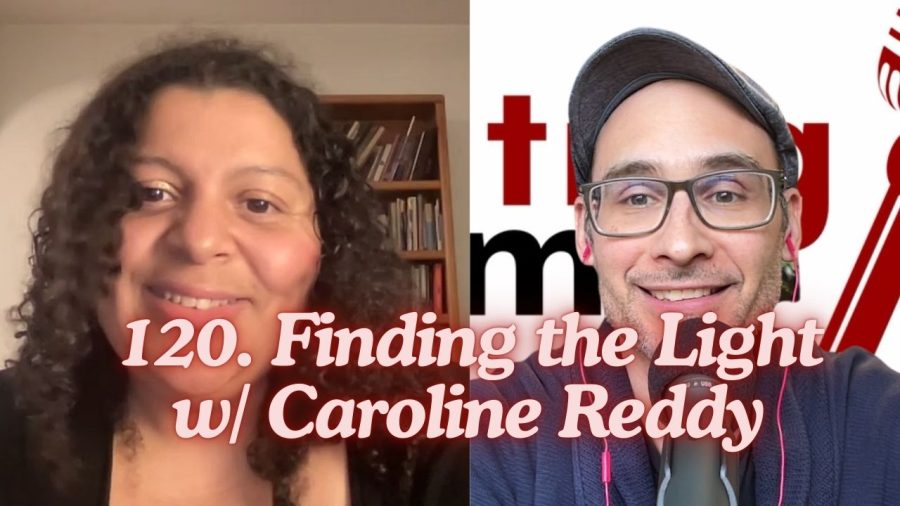
Daniel Dissinger dives deep into a conversation on finding the light with poetry in all of the darkness in the world, in ourselves, and from traumas in our pasts with Reiki Master, Librarian, and Poet Caroline Reddy. This is an episode that celebrates the power of poetry and language and how people can be brought together by celebrating their personal energy and the positive force of a loving community. Caroline talks about some of the adversities and traumas she faced like her childhood memories of war in Iran, immigrating to the US at just eight years old, and finding her voice after her divorce. She talks about her meditation practices, how she uses meditation as part of her writing process, and how poetry has become a grounding practice, so much so that she will be running several workshops at Poet’s House, The New Rochelle Public Library, and The Hudson Valley Writer’s Center (links below to register). Caroline also reads several poems, including “The Basement of Tehran” (which is a poetic account of her experience hiding from bombings as a child), “The Lost Tribe,” and a few haikus rooted in her meditation practice.

Sign up for Caroline’s workshops:
“The Creative Breath” at the New Rochelle Public Library (monthly starting in March)
“The Immigrant’s Voice” at Poets House (Thursdays 6–8 pm on Zoom in March)
“The Immigrant’s Voice” at Hudson Valley Writer’s Center (April and May)

Continue reading “120. Finding the Light w/ Caroline Reddy”