
At the Undergraduate Writer’s Conference at USC, Daniel gave a talk about what he learned from his experiences being a podcaster for the last six years. He shared the stories of both Writing Remix and The Nostalgia Test’s humble beginnings, how COVID impacted the recording process, seeing mistakes as lessons to improve workflow, creating boundaries, confronting burnout, and the importance of being authentic versus having an over-produced podcast.
He also talks about how podcasting taught him so much about who he is as a creative, scholar, and personally, which Daniel sees as the greatest lesson. After the presentation, he answers questions from USC students in the audience about engaging in courageous conversations, the ups and downs of being so public with one’s views, and his approach to preparing for guests.
If you want to book me for workshops, speaking events, and/or to be a guest on your podcast email at writingremixpodcast@gmail.com
Approximate Rundown
00:00 Why Podcasting Matters
02:11 Meet the Host
03:12 My Podcasts & The Humanities Podcast Network
06:23 Lesson One Patience
07:53 Planning & Workflow
09:21 Find Your Why
11:08 Embrace Mistakes
13:08 Make It Meaningful
15:05 Courage & Boundaries
17:59 Authenticity Over Perfection
21:18 Podcasting Builds Community
22:48 Guests & Collaborators
23:31 Unexpected Guests
25:48 Burnout & Breaks
26:42 Planning & Workflow
27:28 Monetization Reality
28:18 Collaboration Mindset
29:31 Editing Less
30:05 Trust Your Instincts
30:49 Numbers Don’t Matter
33:23 Q&A and Research
36:15 Courageous Conversations
40:19 Follow Up Questions
42:40 Editing Approach
45:17 What Podcasting Taught Me
47:16 Closing & Thanks

Daniel Dissinger is a Full Professor in the Writing Program at the University of Southern California, poet, Kerouac scholar, podcaster, and writing coach. He hosts the award-winning podcast Writing Remix, as well as The Nostalgia Test Podcast, and facilitates workshops with Inspired Belonging. He earned his PhD and MA from Saint John’s University, and an MFA from The Jack Kerouac School of Disembodied Poetics at Naropa University. Daniel’s poetry has been published in numerous journals, including the 2026 Altadena Poetry Review. His chapbook, tracing the shape, was published by Shadow Mountain Press.
Daniel co-created a global humanities podcaster network, The Humanities Podcast Network. Since 2021, he helped plan their annual international symposiums and was also the chair of the 2025 symposium “Podcasting & Power.” He is a contributing writer featured in the Palgrave Handbook of Humanities Podcasting (forthcoming), and an HPN workshop leader and co-facilitator.
During the inaugural 2026 Los Angeles Kerouac Festival at Typewriters Anonymous, Daniel gave the keynote talk “The Kerouac We Ignore,” which focuses on father-son relationships, masculinity, and Kerouac’s lifelong search for love of self. At the 2026 Undergraduate Writer’s Symposium at University of Southern California, Daniel presented “What I Learned After 6 Years of Podcasting.”
As the co-founder of Inspired Belonging, Daniel’s approach, inspiration, and passion comes from a deeply personal place. He wants to create community and space for people who, like him, are coping with challenging mental health journeys and the daily stigma that this struggle can bring upon a person’s mind, body, and spirit. Daniel believes in the power of writing and love-centered mindful practices to help nurture a shame-free culture for healing.
Visit:
The Nostalgia Test Podcast
Writing Remix
Inspired Belonging
The Humanities Podcast Network
Daniel’s LinkedIn: https://www.linkedin.com/in/danieldissinger/
People, Texts & Podcasts Mentioned in the Episode
- The Jack Kerouac School of Disembodied Poetics
- Naropa University
- The Humanities Podcast Network
- The Nostalgia Test Podcast
- Twinkie
- 185. Twinkies Anniversary Episode
- Black Lives Matter
- Inspired Belonging
- COVID Pandemic
- George Floyd
- NPR
- Ryan Leack
- 121. Navigating AI & Surveillance in the Classroom w/ Ryan Leack
- Stephaine Renee Payne
- Inspired Belonging Podcast Episodes
- Dr. Shadee Malaklou
- 117. Inspired Belonging w/ Dr. M. Shadee Malaklou
- bell hooks Center
- Camille Hernandez
- 119. The Poet’s Role w/ Anaheim Poet Laureate Camille Hernandez
- Tony Stublebine
- 110. Embracing Authentic Writing w/ Medium’s CEO Tony Stubblebine
- Medium.com
- Scott Barber
- The Orange Years (Movie)
- 40. 🎥🧡The Orange Years: The Nickelodeon Story w/ Director Scott Barber
- Lisa Sorrell
- 118. Crafting Cowboy Boots w/ Lisa Sorrell
- Holly George-Warren
- Tracy Jose
- 82. 📚Nostalgia 101: American Culture & Post-Liberalization India w/ Ms. Tracy Jose
- ZombieCon
- 169. Nostalgia 101: Making ZombieCon Vol. 1 w/ Erin Áine & Kyle Valle
- Amy Myerson
- 29. (Im)Perfecting the Novel w/ Amy Meyerson & Natalie Hallak
- Mike Ferguson
- 158. 📚Nostalgia 101: Mike Ferguson
- Dr. Carmen Kynard
- 44. Practicing Radical Pedagogy w/ Carmen Kynard
- The Wedding Singer (Movie)
“Podcasting is a very, very, very slow burn, and that’s okay […] you have to want to do it […] you have to have a love for what you’re going to do […] to continue. Most podcasts don’t even go past about five to 10 episodes. There are millions of podcasts out there, but the majority of them are abandoned.”
-Daniel Dissinger
“The one thing I’ve remembered, is I’m gonna make a lot of mistakes, and that actually makes the podcast interesting. It’s a human modality. People want to hear a human talk to them. They don’t wanna hear robots, like, just speaking without ‘ums’ and ‘likes’ […] it’s also about connection, and human connection is imperfect. So, you’re gonna make a lot of mistakes. Allow yourself to do that.”
-Daniel Dissinger
“Podcasting is not a money-making machine, so people who do it are really dedicating themselves to something that’s, in a way, kinda Punk Rock because like it’s really imperfect, gritty.”
-Daniel Dissinger
“Perfection is gonna be the death of your content. It’ll be the death of your writing too, trying to be perfect.”
-Daniel Dissinger
“Guests don’t equal numbers.”
-Daniel Dissinger
“It’s not about the big guests that get the numbers, it’s just about […] kind of experience you create. And just have fun […] My friend Manny, who told me during “The Nostalgia Test” ‘Look, if we’re not having fun, we should stop doing this.’ And I was like, ‘Okay’ […] and that changed the whole podcast.”
-Daniel Dissinger
“Podcasting gave me a way to be in this scholastic conversation in a way that no one else was doing at the time, and I’ve been able to publish 123 episodes through the Writing Remix. That’s way more than […] if I went through traditional publishing. Now, I don’t have to try and defend what I’ve done equal to something. So, it’s given me more confidence to be like, ‘If you don’t think that this is equal to that, that’s on you.’ Like I know what I come with. So, it’s given me a lot of confidence in myself as an academic, as a creative, but also as someone who can provide platform for people. And that really has been the greatest lesson, that like even though I’m not the biggest podcaster, people have come on and had such a positive experience, and it’s given me, you know, so much to look back on and be proud of.”
-Daniel Dissinger
Episode Reflection Questions:
- You’re starting a podcast tomorrow, what is the focus of your show and why are you focusing on that particular topic?
- If you’re not a podcaster, how do you share and create space(s) for your art, your voice, and your work?
- How do you create, nourish, and build space for rest as a creative, a scholar, and/or a human being in the world?
129: What I Learned After 6 Years of Podcasting: A Talk at the 2026 Undergraduate Writer’s Conference at USC (Transcript)
The theme song is “4 am” by Makaih Beats. You can follow the podcast & all social media: Linktree, join the newsletter/Follow Dan’s Medium & Follow the Substack to watch the full episode videos
Register For the 2026 Humanities Podcast Network Symposium:
“What to do now?”:
Humanities Podcasting Agency and Avowal
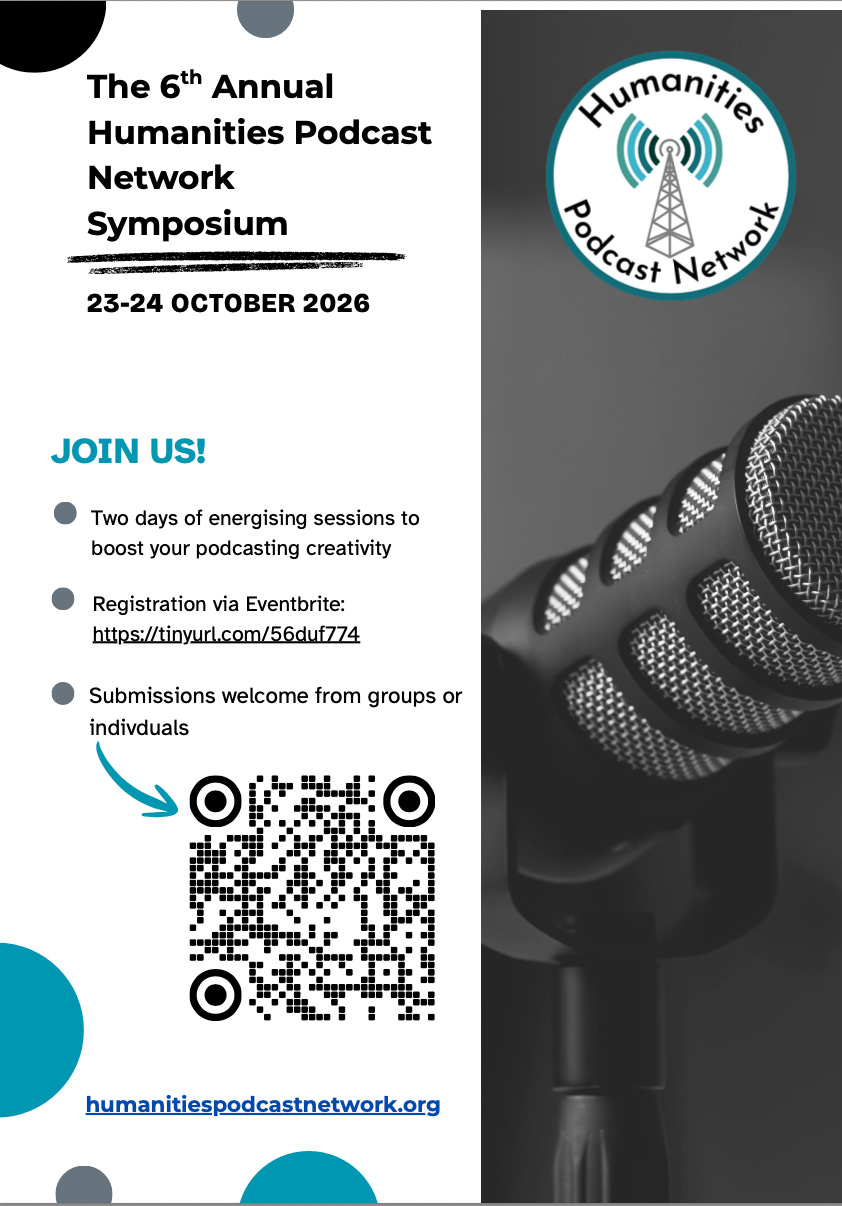
Conference Dates: Friday, October 23 – Saturday, October 24
Location: Virtual
Register to Attend (Free!): HPN Symposium 2026 on Eventbrite
CFP: This year’s Call for Papers is now available! Submit your proposal here.
Due: 5:00 p.m. ET on Monday, September 7
Interested in staying up-to-date with forthcoming announcements? Email Carl Hartley at c.d.hartley@leeds.ac.uk to be added to the HPN JiscMail newsletter.
Introduction
We are living through a moment that tests the nerve of anyone who makes things, says things, or puts ideas into the world. Public institutions are under pressure. Trust in expertise is fractured. The space for independent, thoughtful voices feels both more necessary and more precarious than at any point in recent memory.
For humanities podcasters — whether you work inside the academy, alongside it, or entirely beyond it — these pressures are personal as well as political. Who gets to speak? Who gets heard? What does it cost to say something true out loud, and what does it cost to stay quiet?
The Call
This year’s symposium takes those questions seriously. Agency is about finding and using our power — as creators, as scholars, as communicators — inside systems that were not always built with us in mind (cf. https://www.anthroencyclopedia.com/entry/agency). Avowal is about the harder, quieter work of believing that what we do matters: owning our values, claiming our expertise, and trusting that our audiences are worth showing up for (cf. https://pmc.ncbi.nlm.nih.gov/articles/PMC11543736/).
 Writing Remix Podcast